
Blog

Why Dance at All? Dance to Change Your Life.

Dance is a basic fundamental of life. We all danced sometime in our lives, especially when we were kids.

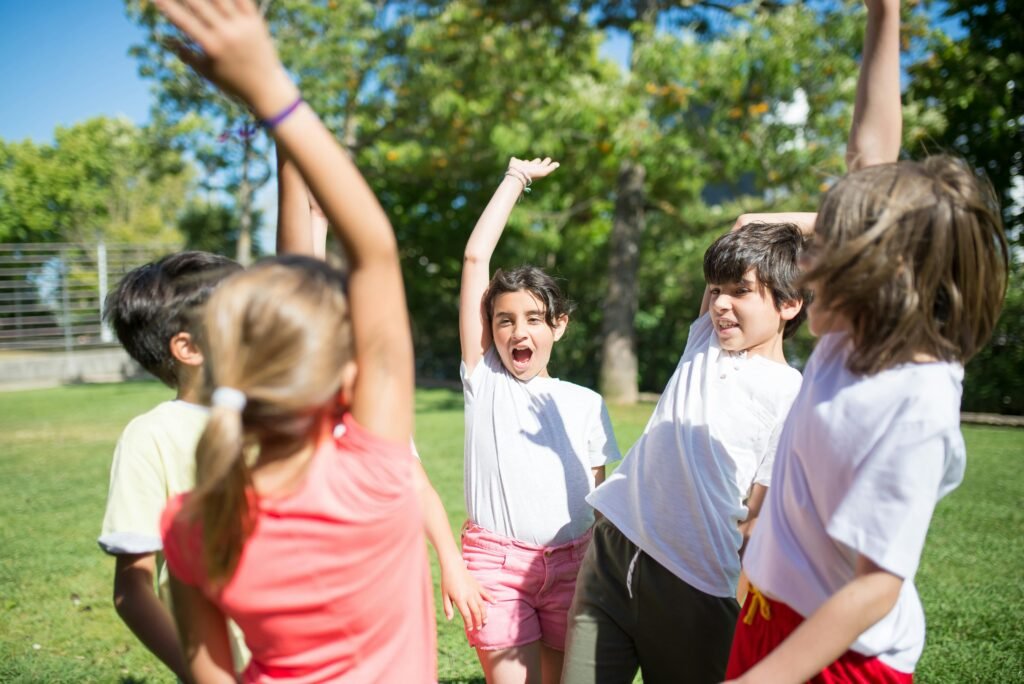
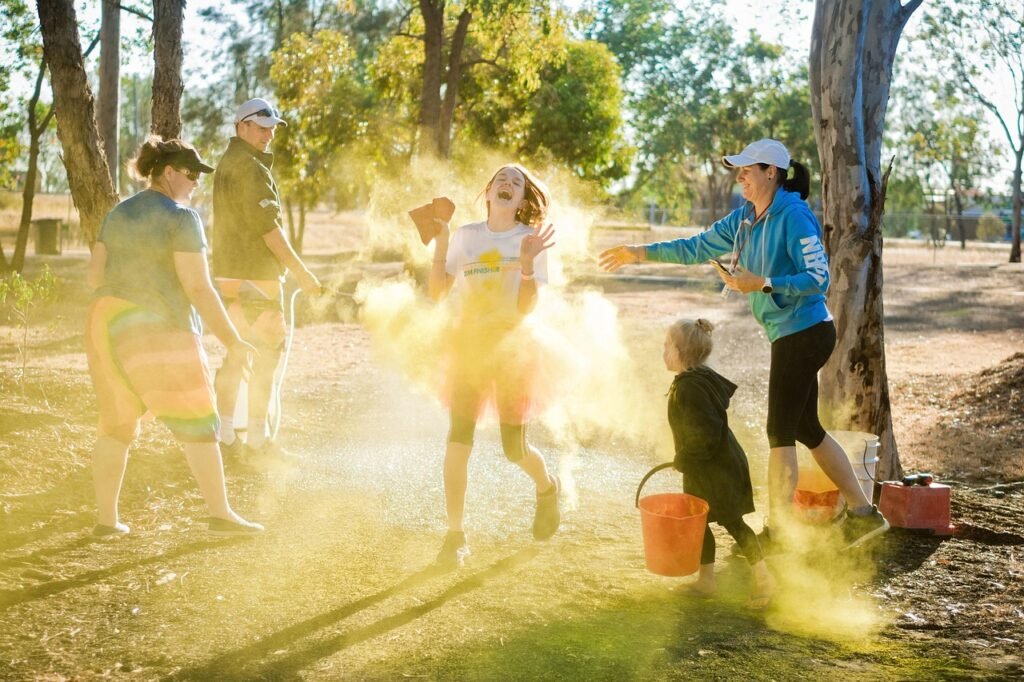
When we were kids, movement was effortless. We ran simply because it felt good. We skipped, leaped, twirled, and devised playful walks that caused our friends to burst into laughter. Our bodies were our playgrounds, and every gesture was a tiny celebration of being alive. Back then, we didn’t call it “exercise” or “dance.” It was just joy expressing itself through motion.
family, game, fun, outdoors, playing, family, family, family, family, family
Remember we ran and danced as kids.

Somewhere along the way, many of us forgot that. We grew up, sat down, and stayed still. But the truth remains: any movement of the body is a dance. And when we bring dance back into our lives, we revive something essential — our love for life, our connection to others, and our sense of freedom. Every human being longs for that freedom of movement. Our bodies crave it. Movement regulates our systems, supports circulation, balances hormones, and oxygenates our cells. It is one of the most natural ways to return ourselves to balance.

But movement is more than biology. It is a doorway to joy. When we consciously choose to move — not out of obligation, but out of curiosity and pleasure — we awaken creativity. We reconnect with the playful, expressive part of ourselves that never truly disappeared. And once that creativity is awake, we can use it to strengthen our relationships. Dance becomes a bridge: a way to connect with friends, family, neighbors, and even new acquaintances without needing the perfect words or the perfect mood. Movement speaks a universal language.

Ecstatic Dancie, practiced in the Joy Rhythm style, amplifies all of this. When done three or more times a week for just twenty minutes, it stimulates the brain to form new neural pathways. It keeps the body pliable and the mind alert. Entire TED Talks explore how dance supports cognitive health, emotional resilience, and long‑term brain function. Research even shows that dance can help delay dementia and Alzheimer’s — a wonderful side effect, though not the primary purpose of Joy Rhythm.

The true purpose of this book is to guide you back into your body and show you how movement can transform your relationships and your daily life. Through Joy Rhythm, you will learn how to create safe spaces where you can express your feelings, emotions, and thoughts without judgment. You’ll discover how simple movements can evolve into dances that bring you joy, clarity, and connection. And you’ll learn how to share that experience with others — not as a performance, but as an invitation. https://www.ted.com/talks/ryan_heffington_how_dance_can_unleash_your_inner_joy

Using this method of Ecstatic Dancie Joy Rhythm will bring vitality, laughter, creativity, and purpose into your life. It will help you build new social connections rooted in authenticity and play. It will remind you that joy is not something you chase—it’s something you create through movement and live.

Blog

Movement Mechanics is the Method for Men

Become a “DAncie” and look good

For many men, the word “dance” is synonymous with “danger.” It represents a unique social trap: a situation where you are expected to move to music, yet feel you lack the blueprint to do so without looking foolish. You might find yourself at a wedding, a gala, or a holiday party, glass in hand, rooted to the spot or performing the “polite sway” because the alternative—coordinated choreography—feels like a foreign language you never learned.

A father dances playfully with his daughter in a sunny field, capturing joy and bonding.
New Way to Move for the Non-Dancer

Ecstatic DAncie Inner National ~ Joy Rhythm is designed specifically to dismantle this paralysis. It isn’t about learning a “routine”; it’s about installing a functional movement operating system that works on any floor, in any setting, without a single rehearsed step.

The Problem with Traditional Dance

Standard dance classes are often built on mimicry. You watch an instructor, try to mirror their limbs, and fail to keep up with the count. This practice creates a “performance mindset,” which is the opposite of relaxation. For the analytical man, this is frustrating because it’s a system with too many variables and no clear logic.

Joy Rhythm flips the script. Instead of teaching you what to do, it teaches you how your body naturally responds to beat and tempo. It treats movement as a form of nervous system regulation. By focusing on internal rhythm rather than external form, you bypass the “critic” in your brain that says you look awkward.

The Utility of the “Anywhere” Method

The true value of the Joy Rhythm method is its portability. You aren’t learning a dance that only works in a studio; you are developing a physical confidence that translates to:

  • Professional Networking: Better posture and body awareness lead to a more commanding presence.  
  • Social Events: The ability to step onto a dance floor at a wedding and actually enjoy the music, rather than counting down the minutes until you can sit back down.
  • Stress Management: It serves as a high-intensity interval session that clears the mental “cache” of a high-pressure work week.

A Controlled Environment for Uncontrolled Movement

We understand that for a man who doesn’t dance, “letting go” can feel risky. This is why Joy Rhythm prioritizes a Safe Space. Our sessions are not performances. There are no mirrors to judge yourself in, no stages, and no “grades.” It is a low-pressure environment where the goal is purely kinetic. You get the cardiovascular benefits of a gym workout combined with the mental clarity of a meditation session, all while solving the “I don’t know what to do with my hands” problem forever.

The Secret Wish: Freedom from Inhibition

Deep down, every man wants to be able to move with the same ease he sees in others. You want to feel the music without the filter of self-consciousness. Joy Rhythm provides the bridge. It gives you the “rhythm mechanics” to feel grounded and capable. You don’t choose Joy Rhythm to become a “dancer”—you choose it to become a man who is no longer sidelined by his own hesitation.

Stop standing on the edge of the room. It’s time to trade the rigid “work-mode” body for a more fluid, resilient version of yourself. Be part of the party.

Blog

Add Spark to your dance connections

Improve your life by exploring Ecstatic Dancie Inner National ~ Joy Rhythm:  

Joy Rhythm addressed key concepts:

Flow: Accept the natural rhythm of your body and how it moves. We even provide you some easy, simple steps to get you started.

Freedom of expression: You need to let yourself express yourself without judgment and shyness. With practice, this becomes simpler and more natural. This dancing style is easy to learn and can help you feel good about yourself, move with confidence, and be present in any location, whether it’s a class, a club, or your own living room. The first Joy Rhythm lesson you take is called “Solo,” and it teaches you all of this.

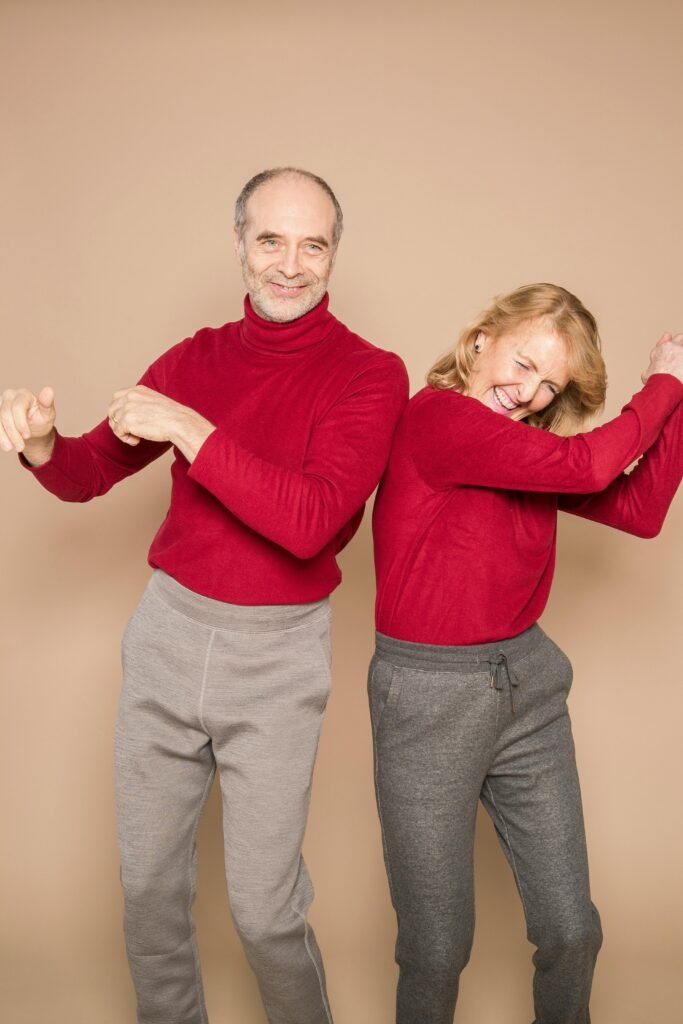
Energetic senior couple in matching red sweaters dancing happily indoors.

Our second course is all on “Connection”: you learn how to connect with people in your community and share your energy with others. At first, this is a little uncomfortable, but that’s where growth comes in. Be present, be aware, and really be in the moment. Listen to your gut. Let your gut feelings guide your actions. Dance to express yourself personally and emotionally. Joy Rhythm is a movement experience that can help you bring back play, connection, energy, and excitement into your life.

Joy Rhythm methods help you get your confidence back so you can move, play, and shine just as you are. This is a way to accept yourself, create you, and connect with others. Learn how to create a fun and judgment-free space. This feature is a significant plus. You don’t have to worry about “doing everything right.”  It’s about having fun, meeting new people, and sharing your joy. This is a dance you can take with you anywhere. Let yourself play and feel like a kid again. You become the person you have been aiming to become. Once you master the portable “Take-It-Anywhere” Method, you may use it to bring joy to your living room, lunch breaks, stroll in the park, or even a full-on dance floor. It becomes a tool you may use to: • raise your mood; • get out of your head; • reconnect with your body; • make you feel like you’re part of something bigger than yourself.

Dance helps you let go of stress. It’s a strong and safe approach to get relief from the stress in our bodies. And doing it with presence and intention can potentially make you smarter and keep dementia and Alzheimer’s at bay. Even better, take care of your physique. Think of it as nature’s gym—no equipment needed, just your willingness to move and courage to dive in for a stronger mind-body bond.

Your body is a dance foundation that will help you rock any dance floor. You will feel good about moving around at a wedding, a club, a retreat, or a beach bonfire. No more lurking at the fringes. You won’t have to worry about whether you’re “doing it right” anymore. Your body learns how to move, how to be present, and how to be in rhythm. These are all things that people are subconsciously drawn to. You look like you know what you’re doing the more you do it. Join communal circles (typically Ecstatic Communities) practically anywhere that lets you meet other people who seek the same things—play, health, and happiness—without feeling self-conscious. This is where friendships start, when someone glances across the room and thinks, “We get each other.”

It takes time, but beat synchronization will come effortlessly. When you reset your neurological system, your stress levels go down, your energy levels go up, and your heart rate settles into a rhythm that feels wonderful, not frenzied. It’s akin to invigorating your mind with a clean, fresh breeze. When you get out of your head and into your body, it’s much simpler to connect with other people. It will truly make you smarter as time goes on! You don’t have to feel like you have to fix yourself before you can have fun again. It takes away the fear of talking to other people and makes it more comfortable.

This practice helps you accept yourself by moving your body. You stop evaluating your body from the outside and start to feel it from the inside, where the wisdom is. The method helps you stop fighting and start trusting yourself. You who thought you were “too stiff” or “too old” are now smiling at your own personal reflection again. Anyone can do simple, guided dance moves that remove the pressure of “looking good.” You learn playful, flowing steps that wake up muscles you forgot you had, loosen your hips, lift your mood, and help you feel positive. You feel coordinated—not because you are perfect, but because the moves make sense and feel comfortable.

Joy Rhythm is a movement experience designed to help you get back in touch with play, connections, and physical vitality and to spice up your life. It’s a simple way to reset your soul via dance that teaches you how to move with confidence, feel safe, and have the warmth to step into any venue—whether it’s a class, a club, or your party—with ease and presence.

Give yourself the permission to shine—just as you are. Here is where you may sign up for your classes.

It’s something you practice.

Now you have a way to become the person you want to be. It’s a way to embrace yourself, create yourself, and connect with others to bring back the joy you have been missing.

Blog

Unlock Joy become an Ecstatic DAncie:


I am known as the “Dancing Queen.” For years, people from all walks of life asked me to teach them my style of dance. At first, I resisted—I thought, This is just how I move, how I express myself. But the requests kept coming, and eventually I decided, “Ok, I will.”

Finish Setup

That decision began a journey of discovery. I asked myself, “What do I do differently from other styles of dance?” It took me over a year of exploration, reflection, and practice to answer that question. Out of that process, Ecstatic Dance Inner National Joy Rhythm was born.

Joy Rhythm is more than choreography—it’s a program and system designed to be taken to any dance floor, with any music, by anyone. It’s about expression of joy, social connection, and fun for all ages. Whether you’re a seasoned dancer or someone who has never stepped onto a dance floor, Joy Rhythm invites you to move freely, release stress, and reconnect with your body.

The benefits go far beyond fun. It builds confidence like no other. Joy Rhythm is a holistic practice that keeps both body and mind in shape. Physically, it strengthens muscles, improves circulation, and boosts energy. Mentally, it stimulates neuroplasticity, enhances creativity, and supports emotional regulation. Spiritually, it opens space for transformation, helping participants reconnect with their authentic selves.

At its core, Joy Rhythm is about freedom and flow. It’s not about performance or perfection—it’s about moving in a way that feels natural, joyful, and healing. It’s a system anyone can learn, but more importantly, it’s a practice anyone can embody.

Group of children playing with raised arms in a sunny park, enjoying summer fun.
Bring back the Joy of Dance and connection

It’s all about free expression, social connection, and fun for all ages, helping you release stress and reconnect with your body. Physically, it builds strength, boosts circulation, and energizes you. Mentally, it sparks creativity and emotional balance. Spiritually, it’s transformative, tapping into your authentic self. Joy Rhythm isn’t about perfection—it’s freedom in motion, blending dance, wellness, and healing. Movement is confidence, rhythm is connection, and joy is your birthright.

Blog

Big Lifestyle Changes Dancie’s use Simple Beginner Steps

Flow: Accept the natural rhythm of your body and how you move. We even provide you with some easy, simple beginner steps to get you going.

First Things First

The first Joy Rhythm lesson is called “Solo,” and it teaches you freedom of expression: you need to let yourself express yourself without judgment and shyness. With practice, this aspect becomes simpler and more natural.

This dancing style is easy to learn; therefore, you learn to feel good about yourself, move with confidence, and be present in any location, whether it’s a class, a club, or your own living room.

Our second lesson is all on “Connection“: you learn how to connect with people in your community and share your energy with others. At first, this is a little uncomfortable, but that’s where growth comes in. Be present, be aware, and really be in the moment. Listen to your gut. Let your gut feelings guide your actions. Dance to express yourself personally and emotionally, with Joy Rhythm. Joy Rhythm is a movement experience that can help you bring back play, connection, energy, and excitement into your life.

Joy Rhythm methods help you get your confidence back so you can move, play, and shine just as you are, even with simple beginner steps. This is a way to accept yourself, create “you”, and connect with others. Learn how to create a fun and judgment-free space. This feature is a significant plus. You don’t have to worry about “doing everything right.”  It’s about having fun, meeting new people, and sharing your joy.

Let yourself play and feel like a kid again. You become the person you have been aiming to become. Once you master the portable “Take-It-Anywhere” Method, you may use it to bring joy to your living room, lunch breaks, stroll in the park, or even a full-on dance floor, because it helps you feel better. 1) Get out of your head; 2) reconnect with your body; 3) feel part of something bigger.

Dance helps you let go of stress. It’s a strong and safe approach to get relief from the stress in our bodies. Doing it with presence and intention can, however, make you potentially smarter and keep dementia and Alzheimer’s at bay. Even better, take care of your physique.

Your body is a dance foundation that will help you rock any dance floor. You will feel good about moving around at a wedding, a club, a retreat, or a beach bonfire. No more lurking at the fringes. You won’t have to worry about whether you’re “doing it right” anymore. Your body learns how to move, how to be present, and how to be in rhythm.

These are all things that people are subconsciously drawn to. You look like you know what you’re doing the more you do it. Join communal circles (typically Ecstatic Communities) practically anywhere that lets you meet other people who seek the same things—play, health, and happiness—without feeling self-conscious. This is where friendships start, when someone glances across the room and thinks, “We get each other.”

It takes time, but beat synchronization will come effortlessly. When you reset your neurological system, your stress levels go down, your energy levels go up, and your heart rate settles into a rhythm that feels wonderful, not frenzied. It’s akin to invigorating your mind with a clean, fresh breeze. When you get out of your head and into your body, it’s much simpler to connect with other people. It will truly make you smarter as time goes on!  You don’t have to fix yourself before you can have fun again. It takes away the fear of talking to other people and makes it more comfortable.

This practice helps you accept yourself by moving your body. You stop judging your body from the outside and start to feel it from the inside, where the wisdom is. The method helps you stop fighting and start trusting yourself. You who thought you were “too stiff” or “too old” are now smiling at your own personal reflection again. Anyone can do simple, guided dance moves that remove the pressure off “looking good. ” You learn playful, flowing steps that wake up muscles you forgot you had, loosen your hips, lift your mood, and help you feel positive. You feel coordinated—not because you are perfect, but because the moves make sense and feel comfortable.

Joy Rhythm is a movement experience designed to help you get back in touch with play, connections, and physical vitality and to spice up your life. It’s a simple way to reset your soul via dance that teaches you how to move with confidence, feel safe, and have the warmth to step into any venue—whether it’s a class, a club, or your party—with ease and presence. Dance isn’t just fun; it’s a full-body workout disguised as play.  As you wiggle, sway, and groove, your heart rate climbs, muscles engage, and tight spots like hips get a glorious stretch.

Blog

Ecstatic Dancie Inner National, Joy Rhythm

Ecstatic Dance came to me not as a performance, not as a technique, but as a lifeline. It is a journey of movement, music, and inner exploration—a practice that blends ancient ritual with modern consciousness work, offering both personal healing and collective joy.
 It is not bound by particular set patterns or rigid choreography. Some call it free-form dancing. For me, it is more than that—it is a way to joy, connection, and self-discovery.
I call my path Ecstatic Dancie Inner National, Joy Rhythm. To become a “Dancie” is to step into a rhythm that is both personal and universal. My style is not about the moves—it is about the intention. That intention is what people feel, even when they cannot name it. Acceptance. Acknowledgement. Connection. Joy. These are the currents that flow through my dance, and they are contagious.
The roots of this rhythm go back to 2016, when illness shadowed my life. I hid it well, or so I thought. Friends and co-workers noticed I wasn’t showing up, but I brushed it off as a collective joke. Then came the moment that changed everything.
I was golfing, proud of a solid swing on the third hole. The next thing I knew, I was in my car, mid-turn at an intersection. My last memory was on the green. Shock washed over me—I realized I had blacked out. My boss and friends had not been joking. I was slipping in and out of awareness without knowing it.
Fear pushed me into action. I resigned from my job, began basic MMS protocols, and moved in with my mother to recover. Within two weeks, the blackouts ceased, though fog and forgetfulness lingered heavily. Autism-like traits surfaced more pronounced, and comprehension was extremely difficult. Still, I pressed forward, determined to heal.
On my way north to Sequim, Washington, I stopped to see my daughter Emerald. She introduced me to ecstatic dance in Oakland and San Francisco. She captivated me, taking me from mainstream gatherings to professional dancer circles. My favorite was the Wednesday night dance in Oakland.
Something shifted. I began to weave my rhythm into every dance I entered. After a while, people asked me to teach them how to dance like me. At first, I laughed—I didn’t know how to teach. But it was clear I was doing something different. It changed the whole room’s character. It was lighter, more fun, and wilder.
So I studied myself. I reflected, experimented, and distilled my practice into four steps. That is how Ecstatic Dancie Inner National, Joy Rhythm, was born. It is not choreography. It is not performance. It is an intention embodied and shared. 
This dance is joy medicine. It is a way of being. It is the rhythm of life itself.

By Paris Humble  JimhumbleAudio.com, for reference to MMS


Blog

Emotions Are Energy Looking for Motion

Emotions are often treated as mental events. We talk about them, analyze them, try to manage them, or push them away. We ask where they came from and what they mean. While this kind of reflection can be helpful, it overlooks something fundamental about how emotions actually function in the body. Emotions are not just thoughts. They are physiological energy states.

Every emotion brings a change in the body. Heart rate shifts. Breath patterns change. Muscles prepare for action or withdrawal. The nervous system mobilizes energy to respond to what is being perceived. This happens automatically, long before the mind has a chance to interpret or label the experience.

Emotion, at its core, is movement preparing to happen.

The trouble begins when that movement is interrupted.

In many situations, we are taught—explicitly or implicitly—not to move with our emotions. We stay still when we want to pace. We stay quiet when our body wants to express. We hold posture when our system wants to release. Over time, emotions that were meant to move through the body become stored instead.

This storage is not emotional weakness.
It is emotional containment.

The body holds what it is not allowed to express. That holding takes energy. It creates tension. It narrows breath. It keeps the nervous system partially activated, even when there is no immediate reason to be.

This is why emotions don’t simply disappear when we ignore them.

They wait.

They wait in tight shoulders, shallow breathing, restless legs, clenched jaws, or a constant low-level sense of agitation. The mind may not feel emotional in the moment, but the body is still carrying the charge.

Movement gives emotions somewhere to go.

Ecstatic dance provides a context where emotional energy can move without needing to be named, justified, or explained. There is no requirement to identify what you are feeling. The body doesn’t need a label to release what it’s holding. It only needs permission to respond.

When movement is self-directed, emotions often begin to shift naturally.

A heavy emotion may express itself as slow, weighted movement. A restless emotion may appear as pacing, shaking, or rhythmic repetition. A muted emotion may first show up as stillness, waiting until the system feels safe enough to engage.

All of these responses are intelligent.

Emotion does not need to look dramatic to be moving. Small movements can release large amounts of stored energy when they are aligned with the body’s needs. A gentle sway can soften grief. A repetitive motion can calm anxiety. A pause can allow anger to settle without being acted out.

This is regulation, not repression.

Ecstatic dance does not aim to amplify emotion. It allows emotion to complete its natural cycle. When emotional energy is given motion, the nervous system updates. It recognizes that expression is possible and that the energy no longer needs to be held.

People often describe feeling lighter afterward, even if nothing specific was expressed consciously. This lightness comes from discharge. Energy that was once contained has moved through.

There is often a misconception that emotional healing requires reliving or rehashing experiences. While that can be part of some processes, it is not always necessary. The body does not need to revisit the story to release the charge. It needs movement that matches the energy state.

Ecstatic dance supports this by prioritizing sensation over narrative.

Attention stays with the body rather than the meaning of what’s happening. This keeps the nervous system oriented to the present moment, where release is safer and more sustainable. Emotions move without overwhelming the system because they are not being intensified through analysis.

Over time, this changes the relationship to emotion itself.

People become less afraid of what they feel because they trust their body’s ability to move through it. Emotions no longer feel like problems to solve. They feel like signals that can be responded to physically and compassionately.

This reduces emotional buildup.

When emotions are allowed to move regularly, they don’t need to accumulate. The nervous system becomes more flexible. Emotional states come and go with less disruption. There is more capacity to feel without being flooded.

This is emotional resilience—not through control, but through flow.

Ecstatic dance does not promise emotional freedom in the sense of never feeling difficult emotions. Life continues to bring challenge, loss, and uncertainty. What changes is the body’s ability to respond.

When emotions are recognized as energy looking for motion, they are no longer feared or suppressed. They are met with movement, breath, and presence.

The body knows how to do this.

It always has.

When we stop asking emotions to behave like thoughts and start allowing them to behave like energy, something profound shifts. The system becomes more honest, more responsive, and more alive.

Emotions move.

And when they are allowed to move, they don’t have to stay.

That movement creates space.
That space creates relief.
And from that relief, clarity and steadiness naturally follow.

Sometimes the most compassionate thing we can do for our emotions is not to analyze them—but to let the body carry them forward, exactly as they are, until they complete their journey.

Blog

Why Play Is a Biological Requirement, Not a Luxury

Play is often treated as something optional. Something we outgrow. Something we earn after responsibilities are handled. Something reserved for children, vacations, or moments when life feels easy. But play is not a reward. It is a biological function.

The nervous system relies on play to stay flexible. Through play, the body explores range, tests boundaries, releases excess energy, and practices adaptation without threat. This is true across species. Young animals play not because they are carefree, but because their systems are learning how to regulate, relate, and respond to change.

Adults are no different.

What changes is not the need for play, but the permission to engage in it.

As responsibilities increase, play is often the first thing to be removed. Movement becomes functional. Expression becomes constrained. Spontaneity is replaced by efficiency. Over time, the nervous system loses one of its primary outlets for regulation.

The absence of play doesn’t usually register as a single problem.
It accumulates.

Life begins to feel heavier. Reactions become sharper. Creativity dulls. The body feels less resilient, more easily overwhelmed. Joy feels distant—not because it’s gone, but because the system that supports it has been underused.

Ecstatic dance restores play in a form that is appropriate for adults.

It does not ask people to act childish or perform happiness. It offers something more subtle and more respectful: unstructured movement without consequence. Movement that exists for its own sake. Movement that responds to curiosity rather than obligation.

This kind of play is deeply regulating.

When the body moves playfully, the nervous system shifts out of constant evaluation. Muscles soften. Breath becomes fluid. Attention widens. There is less focus on outcome and more on experience. This state allows the body to reset patterns that have become rigid through stress or repetition.

Play signals safety.

It tells the nervous system that there is room to explore, to try, to pause, to change direction. That signal reduces vigilance. And when vigilance drops, energy becomes available for healing, connection, and creativity.

Importantly, play does not require high energy.

Play can be slow.
It can be subtle.
It can be quiet.

A gentle sway. A curious stretch. A moment of improvisation that feels good without needing explanation. These small acts of play matter just as much as exuberant movement. They keep the nervous system responsive instead of locked.

Ecstatic dance removes the usual barriers to play.

There is no audience to impress.
No standard to meet.
No narrative to uphold.

This freedom allows people to rediscover movement without self-consciousness. Over time, the body remembers that movement can feel good without being productive. That expression does not have to be justified.

This remembering has ripple effects.

People often notice that after reintroducing play into their bodies, they approach life differently. Problems feel less absolute. Creativity returns. Humor surfaces more easily. There is more tolerance for uncertainty because the nervous system is no longer operating at its limit.

Play also supports emotional resilience.

A nervous system that plays regularly can move between states more fluidly. It can engage and disengage without getting stuck. This flexibility makes it easier to recover from stress, disappointment, or conflict. Life still happens—but it doesn’t lodge as deeply.

This is why play is not a luxury.

It is maintenance.

Ecstatic dance honors this truth by giving adults a socially safe space to move without purpose. To explore without explanation. To feel without interpretation. This isn’t indulgence. It’s care.

When play is restored, joy often follows—not as forced positivity, but as a natural byproduct of a system that feels alive and capable again.

The body does not need play to escape reality.

It needs play to stay responsive within it.

When we stop treating play as optional, we begin to understand why joy returns not when life becomes easier—but when the nervous system is allowed to move freely again.

Play keeps the body adaptable.
Adaptability supports resilience.
And resilience is what allows joy to stay.

That is not luxury.

That is biology.

Blog

Why Every Body’s Movement Is Valid

Many people hesitate before entering a movement space because they’re carrying an unspoken question. Am I doing this right? That question doesn’t come from curiosity. It comes from years of conditioning. Most of us learned early on that movement is evaluated. There are correct forms, acceptable expressions, and invisible standards that determine whether a body belongs or doesn’t. Over time, those standards become internalized.

We stop listening to our bodies and start monitoring them instead. We adjust movement before it even happens. We override impulses that feel unfamiliar. We learn to keep certain expressions small, quiet, or invisible—especially if they don’t match what we’ve been told movement should look like.

Ecstatic dance gently dissolves this hierarchy.

In this practice, there is no correct movement. There is only honest movement. Movement that arises from sensation, not imitation. From impulse, not instruction. From presence, not performance.

This is why every body’s movement is valid.

Validity doesn’t come from aesthetics.
It doesn’t come from rhythm.
It doesn’t come from range or flexibility.

It comes from authenticity.

When movement is self-led, the body reveals what it actually needs. Sometimes that need looks expressive. Sometimes it looks restrained. Sometimes it looks like very little at all. A small shift of weight. A subtle turn of the head. A long pause that allows internal movement to happen quietly.

These movements matter.

They matter because they reflect real-time information from the nervous system. When a body moves slowly, it may be regulating. When it moves repetitively, it may be settling. When it stays still, it may be integrating. None of these states are lesser than others.

They are intelligent responses.

Ecstatic dance removes comparison by design. There is no choreography to follow, no leader to mirror, no expectation to synchronize. Each person becomes their own reference point. This shifts attention inward, where movement becomes less about how it looks and more about how it feels.

This shift is profoundly regulating.

When people stop evaluating themselves, tension decreases. Breath deepens. The body becomes more available to sensation. In this state, movement naturally organizes itself in ways that support balance and release.

Judgment interrupts this process.

When we judge our movement, we reintroduce vigilance. The nervous system tightens. Expression narrows. The body prepares to be corrected rather than supported. Ecstatic dance offers an alternative: a space where judgment is unnecessary because nothing is being measured.

This doesn’t mean boundaries disappear.

Movement remains contained by self-awareness and respect for shared space. Validity does not mean disregard. It means responsibility that comes from presence rather than rules imposed from outside.

In this environment, people often discover movement they didn’t know they were allowed to have.

Gentle movement that feels nourishing.
Awkward movement that releases tension.
Repetitive movement that soothes.
Stillness that feels complete rather than frozen.

As these discoveries accumulate, something deeper changes.

People begin to trust their bodies again.

They stop asking whether their movement makes sense and start noticing whether it feels right. That trust extends beyond the dance space. It shows up in daily decisions, boundaries, and self-expression. The body becomes a source of guidance rather than a problem to manage.

This is why validity matters.

When movement is validated internally, the body no longer needs external permission to exist as it is. It no longer has to earn its place through performance or conformity. It can respond honestly to the moment at hand.

Ecstatic dance is not about expressing more.

It is about expressing truthfully.

For some bodies, truth looks expansive.
For others, it looks contained.
For many, it changes from moment to moment.

All of it belongs.

When every body’s movement is treated as valid, something subtle but powerful happens. People soften. Comparison fades. Safety increases. The room becomes quieter—not in volume, but in pressure.

This quiet allows deeper listening.

And when bodies are listened to rather than judged, they tend to move toward balance on their own. Not because they were instructed to—but because they were trusted.

That trust is the foundation of this practice.

Every body carries its own rhythm.
Every nervous system has its own timing.
Every movement has its own reason for being there.

Ecstatic dance honors this diversity by refusing to rank it.

When movement is allowed to be exactly what it is, the body doesn’t have to perform worthiness.

It can simply move.

And that, in itself, is healing.


Blog

The Nervous System Was Designed to Move—Not Sit Still

Stillness has its place. Rest is necessary. Pauses are essential. The nervous system needs moments of quiet to integrate, repair, and restore. But stillness was never meant to be the dominant state of the human body. It was meant to be one phase in a larger rhythm that includes movement, expression, and release. When stillness becomes constant, the nervous system struggles.

The human nervous system evolved in motion. It learned regulation through walking, reaching, turning, running, stretching, and resting in cycles that flowed naturally throughout the day. Movement wasn’t something scheduled or intentional. It was simply how life happened.

Modern life has changed that pattern.

Many people spend long hours sitting, often holding the same posture while processing large amounts of information. The body remains physically still while the nervous system stays mentally active. This mismatch creates strain. The system is alert, engaged, and responsive—but without the movement it needs to complete its cycles.

Over time, this imbalance accumulates.

The nervous system doesn’t discharge stimulation properly. Muscles remain subtly contracted. Breath becomes shallow without being noticed. Sensory input increases, but physical output decreases. The body is taking in far more than it is allowed to move out.

This isn’t a personal failing.
It’s a systemic one.

The nervous system is not designed to regulate through thinking alone. It regulates through motion. Through shifts in posture. Through changes in rhythm. Through physical responses that signal completion and safety.

When movement is limited, regulation becomes harder to access.

Ecstatic dance restores a missing piece of this equation.

It offers movement that is continuous, self-directed, and responsive rather than repetitive or imposed. This kind of movement speaks directly to the nervous system. It provides the signals the body has been waiting for: You can move now. You can change. You can complete.

These signals are deeply calming.

As people begin to move freely, the nervous system starts to reorganize. Breath synchronizes with motion. Muscles release tension in stages rather than all at once. Attention drops out of constant scanning and into present-moment awareness. This is not relaxation in the passive sense—it is regulation through engagement.

Movement allows the nervous system to cycle naturally.

Activation rises and falls. Energy builds and dissipates. Rest appears organically when it’s needed. These cycles cannot be forced through stillness alone. They require motion to reset.

This is why many people feel restless or anxious when they try to sit still for long periods, even when nothing appears to be wrong. The body is asking for movement—not as exercise, but as regulation.

Ecstatic dance meets this need without overloading the system.

There is no demand for endurance or intensity. The movement adapts to the body’s capacity in the moment. Some days the nervous system wants slow, grounding motion. Other days it wants rhythm, repetition, or expansion. Both are appropriate. Both are intelligent.

When movement is chosen rather than prescribed, the nervous system feels respected.

That respect changes everything.

People often notice that after moving this way, they feel more settled even though they’ve been active. This can feel counterintuitive. We’re taught that calming down means slowing down. But for a nervous system that has been overstimulated while physically still, movement is what creates calm.

Calm comes from completion, not suppression.

The nervous system needs to do something with the energy it has gathered. When it’s allowed to move, it discharges excess stimulation and returns toward balance. When it’s not, that energy remains trapped, showing up as tension, irritability, or fatigue.

This is especially relevant for emotional stress.

Emotions activate the nervous system just as physical threats do. They prepare the body for response. When those responses are interrupted—by social norms, schedules, or expectations—the nervous system stays activated. Movement gives it a safe exit.

Ecstatic dance provides that exit without requiring explanation.

The body doesn’t need to know why it’s moving.
It only needs to move.

Over time, regular movement restores trust between the body and the nervous system. The system learns that activation will be followed by release. It no longer has to stay on guard. This reduces baseline stress and increases resilience.

People feel more capable not because life is easier, but because their nervous system is no longer overloaded by stillness.

Stillness becomes nourishing again once movement has been restored to its rightful place.

The nervous system was never meant to be parked for long periods while remaining alert. It was designed for rhythm—for movement and rest to alternate in ways that support life.

Ecstatic dance honors this design.

It reminds the body that it is allowed to move, change, and respond. That regulation doesn’t come from forcing calm, but from allowing motion to do what it has always done best.

Move energy through.

When the nervous system is given movement, it doesn’t fight for attention. It settles. It adapts. It recovers.

Not because it was instructed to relax—but because it was finally allowed to move the way it was designed to.

And in that movement, balance becomes possible again.